GST Registration and Compliance for Alberta Veterinary Practices
Growing Alberta veterinary practices must understand GST/HST obligations to remain compliant and avoid penalties. Proper GST/HST compliance protects your practice, allowing you to focus on animal care and client service.
Let’s break down what you need to know about when to register, what to charge, and how to stay on top of your filing requirements.
When Do You Need to Register for GST/HST?
The Canada Revenue Agency (CRA) has clear guidelines for when you need to register. According to the CRA, you’re considered a “small supplier” if your total taxable supplies are $30,000 or less over four consecutive calendar quarters. This includes zero-rated supplies. Small suppliers are not required to register for GST/HST but may choose to do so voluntarily.
Once your practice’s taxable revenue exceeds the $30,000 small supplier threshold, the rules depend on how you cross it.
Exceeding $30,000 in a single calendar quarter
If your total worldwide taxable supplies (including those of associates) go over $30,000 in one quarter, you stop being a small supplier at the moment the sale that puts you over becomes due or is paid.
- Your effective registration date is the day of that sale.
- You must apply for registration within 29 days of that day.
- You must charge GST/HST on the sale that put you over and on all later taxable supplies, even if your registration is still being processed.
Example 1 – Exceed $30,000 in one quarter
Your taxable supplies for the year are:
- Q1: $12,000
- Q2: $15,000
- Q3: $15,000 in July, then a $20,000 surgery on August 10
On August 10, your year-to-date supplies for Q3 go from $15,000 to $35,000 for the quarter. You cease to be a small supplier on August 10. You must:
- Register by September 8 (29 days after August 10)
- Charge GST on the August 10 surgery and on all later taxable supplies
Exceeding $30,000 over four consecutive calendar quarters
If you do not exceed $30,000 in any single quarter, but your total taxable sales over the last four consecutive calendar quarters go over $30,000, you stop being a small supplier at the end of the month following the quarter in which you crossed $30,000.
- You remain a small supplier for those four quarters and that additional month.
- Your effective registration date is the day you make your first taxable sale after that month.
- You must apply for registration within 29 days of your first taxable sale after the month, and you start charging GST/HST on the first sale after that month.
Example 2 – Exceed $30,000 over four quarters
Your taxable supplies are:
- Q1: $6,000
- Q2: $7,000 (total to date $13,000)
- Q3: $8,000 (total to date $21,000)
- Q4: $11,000 (year-to-date total $32,000)
You exceed $30,000 at the end of Q4. You remain a small supplier for Q4 and the following month (January). If your first sale after January is on February 5:
- You cease to be a small supplier on January 31
- Your effective registration date is February 5
- You must register by March 6 (29 days after February 5)
- You start charging GST on the February 5 sale and all later taxable supplies
Not exceeding $30,000 and remaining a small supplier
If your total worldwide taxable supplies (including those of associates) are $30,000 or less over the last four consecutive calendar quarters, you remain a small supplier and do not have to register. You may still choose to register voluntarily.
Example 3 – Do not exceed $30,000
Your taxable supplies are:
- Q1: $4,000
- Q2: $6,000 (total to date $10,000)
- Q3: $7,000 (total to date $17,000)
- Q4: $9,000 (four‑quarter total $26,000)
Your total for the last four consecutive quarters is $26,000, which is below the $30,000 threshold. You remain a small supplier and are not required to register for GST/HST, although you may choose to register voluntarily if it suits your situation.
The veterinary industry in Canada is substantial and growing. In 2023-2024, veterinary practices generated $16.9 billion in total economic output, with $10 billion in direct output. With 15,278 actively practicing veterinarians across Canada, representing an increase of 7.9% compared to 2022-2023, the sector continues to expand. As your practice grows, understanding these GST/HST responsibilities becomes essential.
What Services and Products Are Taxable?
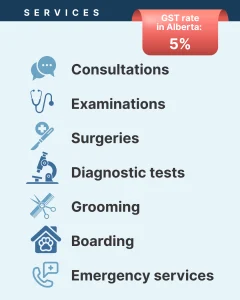
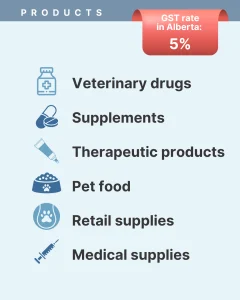
In Alberta, you need to charge 5% GST on your taxable supplies. But what exactly counts as taxable?
Most veterinary services you provide are considered taxable supplies. This includes consultations, examinations, surgeries, diagnostic tests, grooming, boarding, and other services you offer to pet owners and livestock producers.
When it comes to products, the general rule is that most are taxable as well. Drugs specifically labeled or supplied for veterinary use are taxable at the applicable GST/HST rate. This means the medications, supplements, and therapeutic products you sell are subject to GST/HST.
Pet food, supplies, and other retail items you sell through your clinic are also typically taxable. Even if you’re not primarily a retail operation, any products you sell as part of your practice need to have GST/HST applied.
There are very few exemptions in veterinary medicine. Unlike some human health services, which may be exempt or zero-rated, veterinary services don’t generally fall into those categories. It’s best to assume that what you’re providing is taxable unless you’ve confirmed otherwise with the CRA or your accountant.
How to Track GST/HST in Your Practice Software
Accurate tracking starts with your practice management software. Most modern veterinary software systems have built-in GST/HST tracking features, but you need to set them up correctly from the start.
First, make sure your GST/HST registration number is entered into your system and appears on all invoices. Your invoices should clearly show the GST/HST amount charged separately from the base price of your services and products.
Set up your chart of accounts to track GST/HST collected on sales and GST/HST paid on purchases. This separation is crucial because you’ll need to report both amounts when you file your returns. The difference between what you collect and what you pay is what you remit to the CRA (or what they refund to you if you paid more than you collected).
Consider setting up your software to generate reports that match your filing frequency. Whether you file monthly, quarterly, or annually, having reports that align with your reporting periods makes filing much easier and reduces the risk of errors.
Keep detailed records of all transactions. The CRA requires you to maintain supporting documents for at least six years. This includes sales invoices, purchase receipts, bank statements, and any other documents that show your GST/HST collected and paid.
Key Deadlines You Need to Know
Your filing frequency depends on your annual taxable sales. Most growing veterinary practices will file either quarterly or annually.
If you file monthly or quarterly, for businesses with monthly or quarterly reporting periods, both the filing and payment deadlines are one month after the end of the reporting period. So if your quarter ends on March 31, your return and payment are due by April 30.
Annual filers typically have different deadlines depending on their fiscal year-end. If your fiscal year-end is December 31 and you are an individual with business income, your payment is due April 30, with your return due June 15. For corporations and other fiscal year-ends, both filing and payment are due three months after your year-end.
One important note: annual filers with a net tax of $3,000 or more in both the previous and current fiscal years may be required to make quarterly installment payments. This means you’d make estimated payments throughout the year, with a final balancing payment when you file your annual return.
Also, be aware that if your reporting period begins in 2024 or later, you must file your GST/HST returns electronically. Paper filing is no longer accepted for most businesses. You can file through the CRA’s My Business Account, using commercial tax software, or through your accountant.
Setting Your Practice Up for Success
GST/HST compliance doesn’t have to be overwhelming. With the right systems in place and a clear understanding of your obligations, you can manage it as part of your regular financial processes.
Regular reconciliation helps you stay on track. Set aside time each month to review your GST/HST collected and paid, even if you file quarterly or annually. This prevents surprises at filing time and helps you catch any errors early.
A specialized veterinary accountant can set up your systems, maximize input tax credits, and monitor changing GST/HST rules.
At Envision Accounting, we help growing veterinary practices across Alberta understand their tax obligations and stay compliant. If you’re unsure about your GST/HST setup or want to make sure you’re fully compliant, we can provide guidance. Book a Free Financial Assessment to get personalized guidance for your practice.
Frequently Asked Questions
- Do I need to charge GST/HST on emergency after-hours services?
Yes. Emergency services are taxable supplies just like your regular services. You must charge 5% GST on all veterinary services you provide, regardless of when they’re delivered. - Can I claim input tax credits on the GST/HST I pay for practice expenses?
Yes. Once you’re registered, you can claim credits for the GST/HST you pay on eligible business expenses like medical supplies, equipment, rent, and professional services. - What happens if I forget to charge GST/HST on an invoice?
You’re still responsible for remitting the tax to the CRA, even if you didn’t collect it. It’s best to issue a corrected invoice to the client when possible. - Do I charge GST/HST on services provided to farms and agricultural clients?
Yes. Veterinary services for livestock and farm animals are taxable supplies. The fact that your client operates a farm doesn’t change your obligation to charge GST/HST. - How do I register for GST/HST in Alberta?
You can register online through Business Registration Online on the CRA website, through My Business Account, or by calling the CRA’s business enquiries line at 1-800-959-5525. - Should I register for GST/HST voluntarily before reaching the $30,000 threshold?
Maybe – it depends on your expected expenses vs revenues. Registering early allows you to claim input tax credits on significant start-up costs or equipment purchases, which could be beneficial if your initial expenses exceed your revenue, as it can result in a GST/HST refund from the CRA.